By the Australian Supplements Blending team, Smithfield NSW. Published October 15, 2026. Last updated October 27, 2026.
If you are building a sports nutrition, wellness or food powder brand, understanding the powder blending process is the best way to judge any manufacturer. It decides whether your product tastes right, mixes cleanly and stays consistent from the first serve to the last. A recipe on paper is only an idea. It becomes a retail product when the right ingredients are blended together in a uniform, safe and stable way, then packed and labelled to Australian standards.
At Australian Supplements Blending, we run a HACCP-certified food and supplement facility in Smithfield, NSW, offering custom powder blending and contract manufacturing for Australian and International brands. This guide walks through the powder blending process, explaining what happens inside a blending run, why powders sometimes separate, how Australian food and therapeutic rules affect your formula, and what to ask any manufacturer before you commit. It is written for founders, product managers and food businesses who want to understand the process, not just receive a quote.
Key takeaways
- A good blending process is about uniformity: every serve or sachet should contain the same proportions as the formula.
- Particle size, density and moisture decide how easily a blend mixes, and how easily it separates later.
- In Australia, a powder mixed with water or food is generally regulated as a food under FSANZ, while tablets, capsules and medicine-type claims usually point to the TGA pathway.
- Allergen control and correct labelling are manufacturing decisions as much as design decisions.
- Packaging format affects your blend, so choose it early.
What is the powder blending process?
The powder blending process is the series of controlled steps a manufacturer uses to combine dry ingredients into a finished, uniform powder to your specification. Brands usually access it through contract manufacturing. Instead of buying a ready-made product off the shelf, you supply a formula, or work with a formulation team to develop one, and the manufacturer produces it in batches to your brand.
Typical examples include pre-workouts, amino acid blends, hydration and electrolyte mixes, superfood greens, collagen powders, meal replacement powders, baking mixes, cocoa and beverage powders, and commercial seasoning or flavour bases. Each behaves differently. A salt-heavy hydration mix absorbs moisture quickly. A greens blend contains fibrous, low-density ingredients. A protein powder is bulky and slow to flow. A skilled blending partner plans for these differences before the first batch is made.
The powder blending process, step by step
Every manufacturer organises the work slightly differently, but a well-run process in Australia follows the same logic from brief to dispatch.
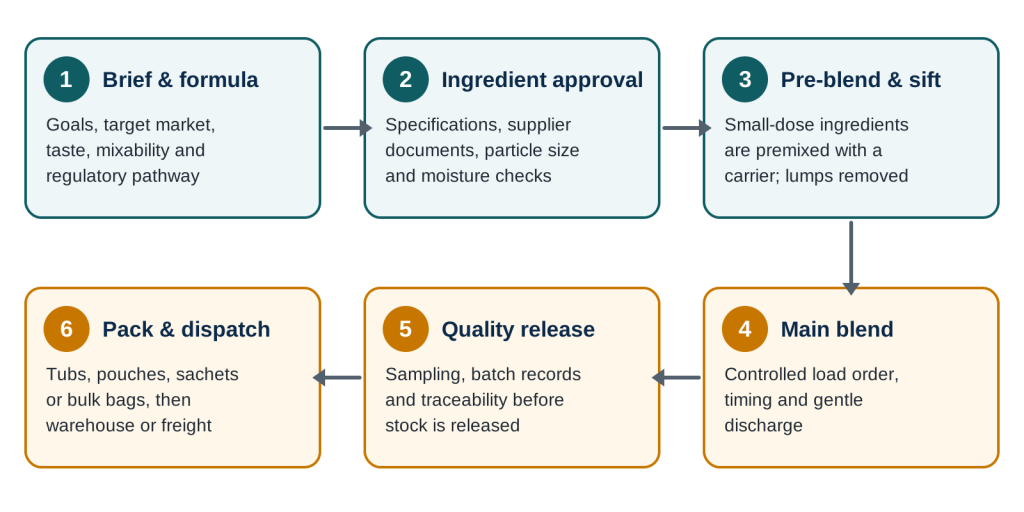
1. Formula and tolerance sign-off
The formula, batch size, loading order and acceptable tolerances are agreed in writing before any ingredient is weighed. Everything starts with a clear brief: who the product is for, how it will be consumed, the target flavour and mixability, and the market claims you want to make. If you already have a tested formula, we scale it. If you need research and development, our formulation team works on taste, solubility, mixability and the stability of active ingredients across sports nutrition, hydration and functional food lines.
2. Ingredient approval and COA check
Every ingredient is checked against its specification and certificate of analysis before it enters a batch. Particle size and moisture matter here, because two ingredients that look similar can behave very differently in a blender. This is also the stage to confirm that every ingredient is permitted for your product type in Australia.
3. Pre-blending and sifting
Small-dose ingredients are pre-mixed into a larger portion of carrier and sifted before they join the main batch. Ingredients used in tiny amounts, such as intense sweeteners, flavours, colours or certain actives, are mixed into the carrier first. Sifting breaks up lumps. This is standard good practice because a very small ingredient dropped straight into a very large batch is difficult to distribute evenly.
4. Timed main blend
The main blend runs to a set loading order, blend time and discharge method, so the powder is uniform without being over-mixed. Over-blending can be as harmful as under-blending, because continued movement can encourage some powders to separate by size or density.
5. Homogeneity check and quality release
The batch is sampled, verified against specification and documented before it is released for packing. Release records typically include the batch record, allergen information for the batch and retained samples. Batch tracking gives you traceability if a question ever arises about an ingredient or a production date.
6. Packing, labelling and dispatch
The released blend is packed into the format your customers will see, then stored or dispatched. Where a brand also needs warehousing and shipping, 3PL and fulfilment services keep production and logistics under one roof. Australian Supplements Blending offers 3PL and fulfilment services as well.
Why powders separate, and how good manufacturers prevent it
The biggest technical risk in the powder blending process is not mixing. It is unmixing. A blend can look perfect leaving the blender, then separate during discharge, transport or packing. This is called segregation, and it is why the first scoop from a tub can taste or perform differently from the last.
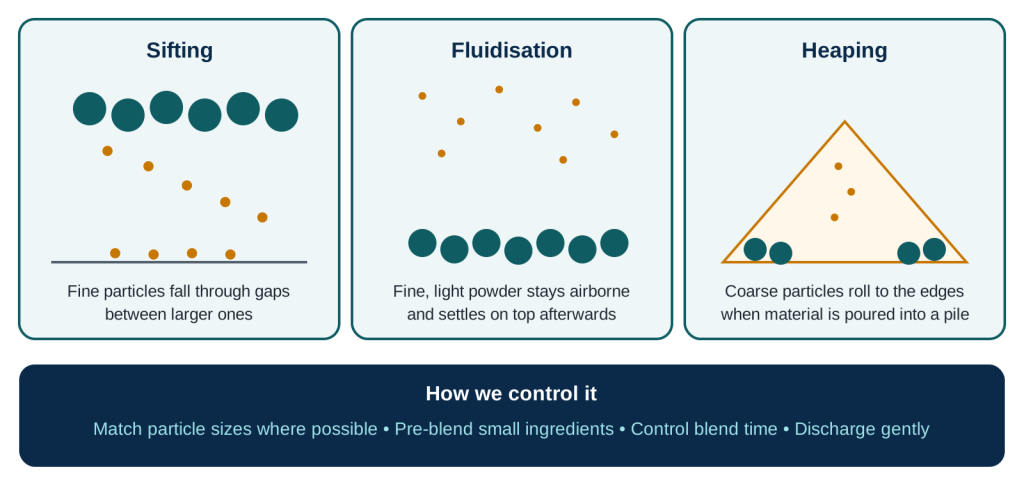
Technical literature on powder handling describes several mechanisms. In sifting segregation, fine particles pass through the gaps between larger ones, and this becomes a real risk when particle sizes differ by roughly three to one. In fluidisation segregation, fine, light particles stay suspended in air and settle later. In heaping, coarse particles tend to roll to the outside of a pile when powder is poured or discharged.
The practical defences are straightforward. Choose ingredient grades with compatible particle sizes where the formula allows. Pre-blend small additions into a carrier. Use a controlled, consistent blend time rather than “more is better”. Minimise drops, vibration and long transfers between the blender and the pack. Every one of these is a manufacturing decision, which is why the experience of your blending partner matters.
Methods of mixing powders: matching the blender to your formula
Powder blenders come in several designs. Tumbling blenders such as V-blenders and double-cone blenders move powder gently and suit delicate, free-flowing materials. Ribbon blenders use a helical agitator for more intensive mixing and are widely used for general powder blends. Paddle blenders often suit fragile, segregation-prone or density-variable materials. No single design is best for everything, and the right choice depends on how your ingredients actually behave.
When we review a formula, these are the questions that shape the approach:
- Ingredient ratios: a few grams of an active in many kilograms of base needs a premix step.
- Particle size and density: large differences increase segregation risk.
- Moisture behaviour: hygroscopic ingredients, common in electrolyte and mineral blends, attract humidity and can clump.
- Flow and static: cohesive or fluffy powders such as greens and collagen can bridge, cake or cling.
- Fragility: some ingredients should not be over-processed.
If you are reviewing manufacturers, ask which equipment and controls they use for your type of formula and why. A confident answer is a good sign. You can see our capabilities and production process for how we structure formulation, blending, allergen control and packing.
Food or therapeutic good? Understanding the Australian pathway (FSANZ vs TGA)
Australian regulation matters before a single kilogram is blended, because it determines what your formula can contain, what you can say on the label, and which standards your manufacturer must meet.
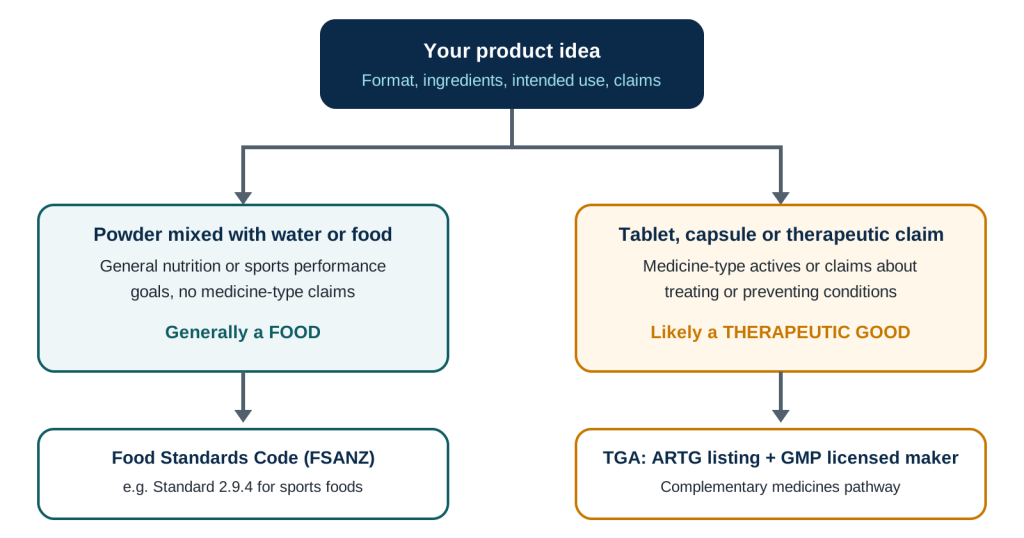
As a general rule, a powder that is mixed with water or food and consumed as part of a diet to meet nutrition or performance goals is regulated as a food under the Australia New Zealand Food Standards Code. Sports powders may fall under Standard 2.9.4, which covers formulated supplementary sports foods, including limits on certain ingredients and rules on how vitamins, minerals and caffeine can be used and described. Supplements in tablet or capsule form, and products making therapeutic claims, are usually treated as therapeutic goods. Those are regulated by the TGA, listed on the Australian Register of Therapeutic Goods, and made by manufacturers working to medicine-level good manufacturing practice.
The line can be fine, and the risk of misclassification is real. We work with food-grade powders, sports nutrition, functional foods and commercial food powders. If your product is likely to be a therapeutic good, we will tell you early so you can choose the right manufacturing route. Formal advice should come from FSANZ, the TGA, the NSW Food Authority or a regulatory specialist.
Allergen control and labelling
Allergen management is where manufacturing and compliance meet. Facilities that blend milk-based, soy-based and allergen-free products need segregation, cleaning procedures and verification to prevent cross-contact. Without these, a “dairy-free” tub can end up carrying a risk it should never have had.
On the labelling side, Standard 1.2.3 of the Food Standards Code requires mandatory allergen declarations, and the Plain English Allergen Labelling (PEAL) rules now govern how most packaged foods must present them, using prescribed names and formatting. Precautionary allergen labelling, the “may contain” statements, sits outside PEAL and should reflect a genuine, assessed risk, not a guess. Your manufacturer should give you accurate allergen information for every batch so your label designer can get it right. See the FSANZ website for the current requirements.
If you plan to describe your product as “Made in Australia” or “Product of Australia”, origin claims are covered by the Country of Origin Food Labelling Information Standard and the Australian Consumer Law, so confirm the rules before your artwork goes to print.
Packaging formats and why they affect the blend
Packaging is not an afterthought. A fine, static-prone powder that runs smoothly into a tub may behave very differently in a stick pack. Stick packs and sachets use very small fill weights, which put extra pressure on blend uniformity. Large tubs and bulk bags can exaggerate segregation if the powder drops or vibrates during filling. The table below summarises the main sectors and pack formats we handle.
| Sector | Example formulations | Typical packaging |
|---|---|---|
| Sports performance | Whey protein concentrate and isolate, plant proteins, pre-workouts, BCAA and EAA blends | Rigid tubs (bulk and retail), gusseted pouches |
| Advanced hydration | Electrolyte blends, magnesium glycinate blends, amino complexes, taurine formulations | Stick packs, retail sachets, specialised tubs |
| Functional foods | Superfood greens, powdered whole foods, health baking mixes, collagen, meal replacements | Stand-up pouches, wide-mouth canisters, jars |
| Commercial food powders | Spice blends, cocoa and beverage powders, dairy blends, powdered bases and flavour systems | High-volume gusset pouches, bulk commercial bags |
Explore the full range on our sectors and product matrix page.
What affects the cost and lead time of the powder blending process?
Prices depend on your specific project, so any manufacturer who quotes before reading your formula is guessing. These are the main drivers:
- Ingredients: quality grade, origin and availability, particularly for premium actives.
- Batch size: larger runs usually reduce the cost per unit; smaller runs offer flexibility.
- Formula complexity: more ingredients, premixes and small-dose additions require more handling.
- Development work: R&D, trials and flavour matching add time at the start.
- Packaging: stick packs and sachets are more labour-intensive than bulk bags.
- Testing and documentation: the depth of verification you require.
- Logistics: storage, fulfilment and freight to your customers.
Brands that want to start lean can ask about stock formulas, which are designed for lower pricing, quicker lead times and smaller batch runs than a fully bespoke formulation. Our private label service explains how stock and custom formulas work.
Five common mistakes brands make with custom blending
- Finalising packaging last. Changing from a tub to a stick pack late can force a reformulation or a new blend plan.
- Ignoring the regulatory pathway. Decide whether the product is a food or a therapeutic good before development, not after.
- Chasing a long ingredient list. More ingredients means more segregation, flavour and stability challenges.
- Skipping a pilot batch. Real-world mixability, taste and flow only show up in production conditions.
- Treating the manufacturer as a vendor, not a partner. The best results come when formulation, production and logistics talk to each other early.
How Australian Supplements Blending can help
We are a manufacturer, not a broker. From our Smithfield, NSW facility, we support Australian brands with formulation and R&D, high-homogeneity powder blending, allergen-controlled packing, private label manufacturing and integrated 3PL logistics. We handle formats from tubs and jars to sachets, stick packs and bulk bags, and we treat your recipes as confidential intellectual property.
If you want to see how we have supported brands in specific categories, read our guides on electrolyte supplement manufacturing and on working with a contract supplement manufacturer in Australia.
Frequently asked questions
What is the process of blending powders?
It is the series of manufacturing steps that turns dry ingredients into a uniform finished powder, following your own formula or one developed with the manufacturer. In Australia it covers formula and tolerance sign-off, ingredient approval, pre-blending and sifting, a timed main blend, quality release and packing, all run to FSANZ or TGA requirements depending on the product.
What are the different methods of mixing powders?
The three common methods are tumble blending, ribbon blending and paddle blending. Tumble blenders such as V-blenders and double-cone blenders move powder gently and suit delicate, free-flowing materials. Ribbon blenders use a helical agitator for more intensive general mixing. Paddle blenders suit fragile, segregation-prone or density-variable powders.
What is a blending powder?
A blending powder is a dry ingredient or premix that is combined with other powders to make a finished blend, such as a carrier, sweetener, flavour or active ingredient. The term is also used loosely for the finished powder itself, for example a pre-workout, electrolyte mix or greens blend made by a contract manufacturer.
Do I need my own formula to start?
No. You can bring a fully tested formula, request R&D and custom formulation development, or begin with a stock formula that offers lower pricing and smaller batch runs.
Is a sports powder a food or a medicine in Australia?
Powders that are mixed with water or food for general nutrition or sports performance are generally regulated as foods, with sports foods covered by Standard 2.9.4. Tablets, capsules and products with therapeutic claims usually fall under the TGA. If you are unsure, check with FSANZ or the TGA before development.
How do you keep a blend consistent from the first scoop to the last?
By matching ingredient characteristics where possible, pre-blending small additions, controlling blend time, discharging gently and verifying batches before release. Packaging choice also plays a part.
Can you also store and ship my products?
Yes. Our in-house 3PL and fulfilment services cover warehousing, inventory management and B2B and direct-to-consumer dispatch, so production and logistics stay connected.
Ready to talk about your formula?
Tell us about your product, your target market and whether you have a formula or need R&D support. Contact the Australian Supplements Blending team to start the conversation.
Sources and further reading: Food Standards Australia New Zealand (FSANZ) for Standards 1.2.3 and 2.9.4; Therapeutic Goods Administration for complementary medicine requirements; NSW Food Authority for guidance on formulated supplementary sports foods. This article is general information, not legal or regulatory advice.
Written by
Australian Supplements Blending
The Australian Supplements Blending team runs our HACCP-certified facility in Smithfield, NSW. Our formulation, blending, quality and fulfilment staff write these guides from hands-on experience making powdered supplements and food products for Australian brands, from custom formulation and private label through to packing and 3PL dispatch.
About our team and facility